ROTH2 (formerly Roth SA and later Roth Mions), originally specialising in the manufacture of pressure tanks, was established in its present form in 1975 to incorporate hot spinning technology. This technology is the basis of ROTH2’s expertise in the manufacture of equipment such as hydropneumatic accumulator bodies, diving cylinders and other industrial applications. Hot spinning is the plastic deformation of metals, called flowing, between a mandrel and one or more rollers, between which the material flows. The selection of rollers, which are available in different diameters, profiles, thicknesses and materials, depends on the size of the blank, the type of material, the radii of the product and the desired surface finish:

The company offers a wide range of products (from 0.2l to 260l) manufactured in small or large series, and strives to offer the best possible service in terms of reactivity, customisation of production, response to customers’ needs and search for the most suitable solutions.
The company’s activities are certified by ASME (American Society of Mechanical Engineers), National Board, SELO (China) and various classification offices for maritime activities (Bureau Veritas Marine, DNV-GL, ABS, RINA). In our opinion, these certifications constitute barriers to entry into the company’s markets, as we shall see below. The business is also supported by an ISO 9001 certified quality management system.
All products are manufactured from seamless stainless steel tubes (typically supplied by Vallourec, Dalmine, Voestalpine, etc.) using the hot spinning and/or hammering technique, for which the company’s expertise is recognised.
This expertise is the result of the know-how accumulated by the teams of technicians in forging, heat treatment, hydraulic testing, hot blasting, painting…In total, the company produces today (2021) about 25,000 units (cylinders and accumulators), with a workforce of 48 employees at year-end 2022 in Mions, France, from where it serves 26 national markets.
Accumulator shells and diving cylinders:
The company’s activities to date have been focused on two historical markets: the recreational diving cylinder market and the hydropneumatic accumulator body market.
Accumulator bodies are energy reservoirs and essential components of hydraulic accumulators manufactured by ROTH2’s customers. An hydraulic accumulator is a tank in which an incompressible liquid is held under pressure by an external mechanical source. This external source can be a motor, a spring, a weight or a compressed gas. An accumulator allows an hydraulic system to manage peak demand, to respond more quickly to temporary demand and to regulate flows. It is an energy storage application. Compressed gas accumulators, also known as hydropneumatic accumulators, are by far the most common type of accumulator.
At ROTH2, a range of volumes (0.2 to 260l) and diameters (57mm to 229mm) with pressures up to 1000 bar are available for accumulator bodies, all in compliance with European, American, international and marine specific standards. The tubes used and the heat treatment guarantee operating temperatures from -60 to +350° C.

These accumulators are used in a wide variety of industries/applications, including Airbus A340 braking systems, Formula 1 suspension systems, oilfield cooling systems, hydraulic presses, pulsation dampening, etc.
For its second activity, all ROTH2 diving cylinders, from 2.5 to 20l can be customised to the needs of the retailers (accessories, colour, printing etc…). Two product lines are available in 230 and 300 bars: air and nitrox. The ROTH2 cylinders have an excellent image and the ROTH name is a symbol of quality in the diving world.

The industrial process :
The manufacture of accumulator bodies and cylinders includes the following steps:
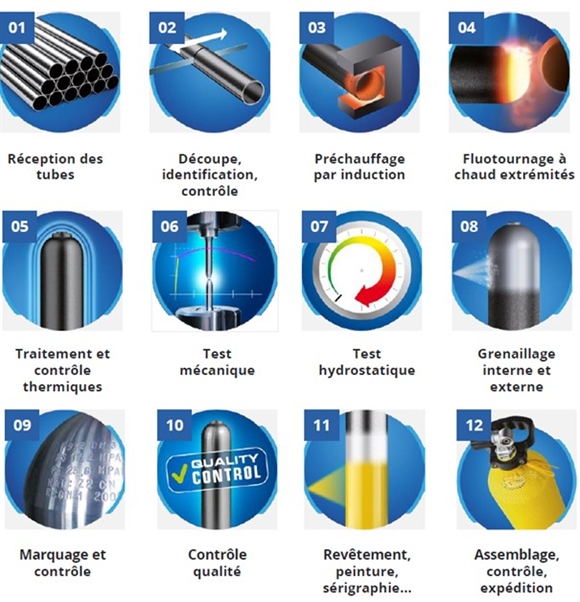
All of these steps are carried out at the Mions, France plant, which has a total capacity of about 60,000 cylinders per year and currently produces about 25,000. The increase in production could be facilitated by an increase to three shifts (from the current two shifts), the automation of some tasks and weekend work, which the company does not currently use. The location of the factory is a competitive advantage at a time when clients are looking for proximity to suppliers to ensure fast delivery times and controlled economic transport conditions. As an industrial company, ROTH2 is also in a good position to benefit from possible public aid in the current political context insofar as it ensures the preservation and development of national and local industrial employment, in addition to those intended for the energy transition.
ROTH2 focuses on type I tanks, the most common type, generally made of steel:
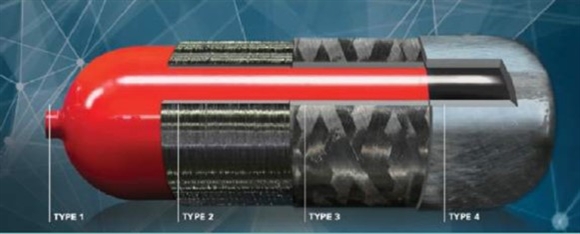
Type I tanks are cylindrical tanks made of metal (aluminium, carbon steel, stainless steel or titanium).
Type II tanks are made of a metal shell reinforced with resin impregnated fibres.
Type III tanks are reinforced with metal liners.
Finally, Type IV tanks are additionally reinforced with a polymer liner.
The main differences between the four types of tanks are cost and weight. Type I tanks are the heaviest, but the cheapest and most commonly used.
The hydrogen opportunity:
Based on its know-how, the company plans to expand into the promising market of hydrogen storage tanks. The initial idea being that the company benefits from the skills needed to develop and manufacture hydrogen tanks, ROTH2 intends to take advantage of the expected strong growth in the consumption of this gas, which is obviously based on the energy transition and the possibility of producing energy with a low (or even zero) carbon footprint:

Current applications of hydrogen :
Hydrogen is already used in a number of industries (oil and chemical in particular) due to its properties for oil refining (desulphurisation), ammonia production (nitrogen hydrogenation), methanol or steel production (direct reduction). Other applications include use in other chemical production, plastics synthesis, certain processes in the glass industry and in the manufacture of electronic printed circuits. Worldwide, nearly 60 Mt of hydrogen are consumed per year, including about 1 Mt in France, according to the following distribution by destination:
Promising developments:
Within the framework of the energy transition, the development of the use of hydrogen will be spectacular, in that it guarantees the production of energy that does not emit CO2, provided that it is produced upstream by green electricity. On the basis of this observation, all intermediaries expect a sharp increase in the production and use of hydrogen for a wide range of applications: road transport, through the use of fuel cells for an industry that is particularly difficult to “decarbonise”, air and sea transport, buildings, energy-intensive industries, power generation, etc.
In the end, the weight of hydrogen in the energy mix is set to grow to reach, according to the European Commission, around 15% of the total by 2050:

Numerous government plans, in Europe and around the world, have already been announced to support this energy transition. To mention only the most recent, let us refer to a €7bn plan aimed at the hydrogen sector in France by 2030 (support for research and innovation, emergence of a French electrolysis sector, etc.), the German plan (€9bn) to produce 5GW of green hydrogen by 2030 and 10GW by 2040, or the Spanish objective of developing the fleet of fuel cell electric vehicles (estimated cost €9bn, source: France Hydrogène). In total, 18 countries representing 70% of the world’s GDP have announced similar plans according to the Hydrogen Council, while 66 countries have a zero carbon target for 2050, which gives an idea of the strong support for the use of hydrogen and its growing use in many industrial sectors:
Source: Hydrogen Council, McKinsey
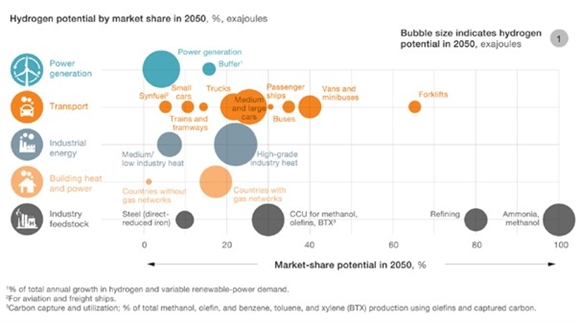
Hydrogen’s destination markets and growing adoption would, according to the Hydrogen Council, lead to an explosion in consumption by mid-century, particularly in the transport, power generation and industrial sectors:

ROTH2’s hydrogen offering will be geared towards the transport sector and industrial applications.
Mobility markets :
As we will see below, the markets targeted by ROTH2 are those of mobility (e.g. tanks and reservoirs typically used in hydrogen distribution stations). These markets are set to develop considerably, given that the transport sector is one of the most polluting in terms of greenhouse gas emissions (20% of the world total according to the IEA). It is therefore one of the main sectors where the development of hydrogen use will be favoured, with very substantial potential savings in terms of emissions:

The same sources suggest that 10 to 15 million vehicles will run on hydrogen by 2030, representing 1 in 12 vehicles in countries such as Germany and South Korea, and that this figure will rise to 400 million by 2050 (private vehicles), to which will be added 5 million trucks and 15 million buses. By type of transport, the Hydrogen Council estimates the following dates for the competitiveness of the use of hydrogen as a fuel:

Globally, about 15,000 stations would be needed by 2030 or 2040 (compared to about 500 today) to serve the 10 million or so vehicles involved, which gives a fairly good indication of the pace of infrastructure development needed for the hydrogen economy. The infrastructures already announced are about 5,000 in total by 2030, i.e. ten times the existing number and a third of the estimated needs at that time:

It is precisely in this market that ROTH2 intends to develop its offering of hydrogen tanks (ground installations), whose growth should logically follow that of the recharging stations:

Source : HRS
The ROTH2 offer
Hydrogen is a particularly light gas: one litre weighs only 90 mg at atmospheric pressure, so it is about 11 times lighter than ambient air. It takes a volume of about 11 m3 to store just 1 kg of hydrogen. It is therefore essential to increase its density and several techniques exist for this purpose:
- storage at high pressure in gaseous form
- very low temperature storage in liquid form
- solid hydride-based storage
For reasons of technical “maturity”, industry is focusing on high-pressure gaseous storage, which also has the advantage of rapid charge/discharge. This is where ROTH2 comes in, offering storage solutions (especially for stations or installations of a certain size) where type I tanks are particularly suitable (lower price and less weight).

Based on its technical know-how, ROTH2 intends to address the hydrogen storage market, initially as a complementary activity, but whose expected growth rates should lead it to become the majority share of its business in the short and medium term (see the section “Profit mechanisms”). The bottles will be sold in the form of customised racks, each of which contains several bottles, allowing the desired volumes to be achieved.

The competitive environment
According to its management, ROTH2 has one main competitor in the type 1 tank segment in Europe: the Czech company Vitkovice. In the diving segment, the company also has to contend with the Italian Faber Cylinders, which is less present in certain other type 1 segments, although it is also active in this area. It should be noted that ROTH2 benefits from industrial and commercial agreements for the exclusive distribution of certain Vitkovice products (for example, for pressures up to 1000 bars) in Western Europe, the latter’s “natural” orientation being more towards the East. Vitkovice has a turnover of over €200m and claims to be the world’s number one. It is present both in the accumulator body segment and in fire extinguishers, equipment for the food and medical industries, and diving cylinders. Other competitors exist in type I tanks (such as the English company Chesterfield SC, the Franco-Chinese company CLD-Faurecia or the American company Steelhead), but ROTH2’s management considers them to be less present in the markets it is targeting, namely Europe and type I tanks. It should be noted, as a precaution, that nothing indicates that these groups will not have the same objectives as ROTH2 on the promising markets linked to the development of hydrogen, as many of them mention in their external communication (Faber, Chesterfield, Steelhead). In any case, the opportunities linked to the development of the use of hydrogen as an energy source leaves room for multiple players, so that the potential growth of the total market is the main variable, rather than market shares, which are still difficult to evaluate. Nevertheless, it can be noted that the current players in Type I to IV tanks will benefit from significant barriers to entry in the future, in terms of experience, know-how and the certifications they have obtained over time. This is of course the case for ROTH2, which has a long history in the sector.